

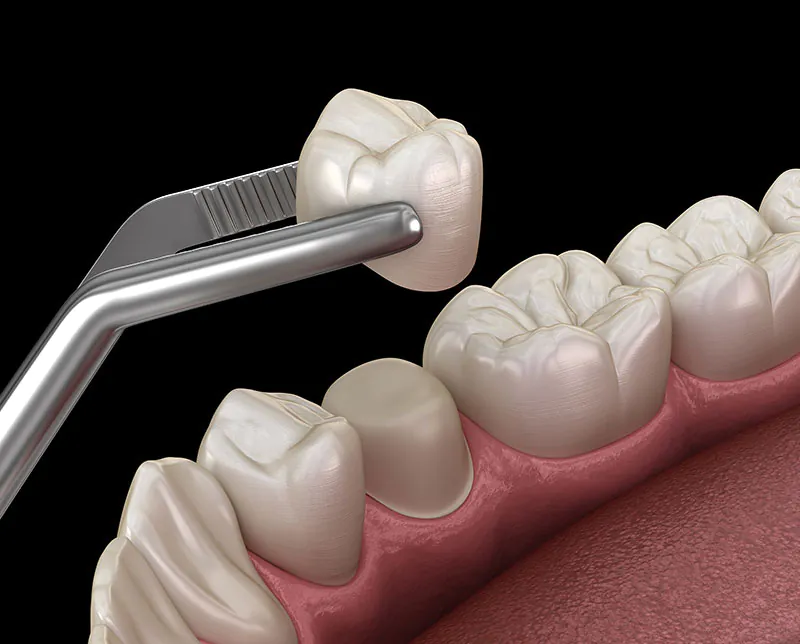
If you have a damaged tooth or are missing one or more teeth, your dentist may recommend a dental crown or bridge to restore your smile. While both are restorative dental treatments, they serve different purposes.
Understanding the difference between crowns and bridges can help you better understand your treatment options and why your dentist may recommend one over the other.
What Is a Dental Crown?
A dental crown is a custom-made restoration that fits over the visible portion of a damaged or weakened tooth. Sometimes called a “cap,” a crown restores the tooth's shape, size, strength, and appearance.
Crowns can be made from several materials, including tooth-colored ceramic or porcelain, allowing them to blend naturally with the surrounding teeth.
Your dentist may recommend a crown when a tooth has:
- Significant decay
- A large filling that has weakened the tooth
- A crack or fracture
- Experienced significant wear
- Undergone root canal therapy
- Structural damage that cannot be adequately treated with a filling or bonding
A crown can protect the remaining natural tooth structure while restoring its function.
What Is a Dental Bridge?
A dental bridge is used to replace one or more missing teeth. A traditional bridge typically consists of one or more artificial teeth, called pontics, supported by dental crowns placed on the natural teeth next to the gap.
The bridge essentially “bridges” the space created by missing teeth. It can restore your ability to chew and speak while also helping prevent surrounding teeth from shifting into the open space.
Depending on your treatment needs, several types of dental bridges are available. Your dentist can recommend the appropriate option based on the location of the missing tooth, the condition of your surrounding teeth, and your overall oral health.
Dental Crowns vs. Bridges: What Is the Difference?
The primary difference between a crown and a bridge is what they are designed to accomplish.
A crown restores an individual tooth that is damaged or weakened. A bridge replaces a missing tooth or several consecutive missing teeth by using surrounding teeth or other dental structures for support.
In other words, a crown generally restores a tooth that is still present, while a bridge fills a space where one or more teeth are missing.
When Is a Dental Crown the Better Option?
A dental crown may be recommended when your natural tooth is still present but has been significantly damaged or weakened.
For example, if you have a tooth with extensive decay or a large filling that has compromised its strength, a crown can provide additional protection. Crowns are also frequently used following root canal treatment because the procedure can leave a tooth more susceptible to fracture.
If the tooth is healthy enough to be preserved, restoring it with a crown can help you maintain your natural tooth rather than replacing it.
When Is a Dental Bridge the Better Option?
A bridge may be appropriate when you have one or more missing teeth and the surrounding teeth are healthy enough to support the restoration.
Replacing a missing tooth can be important for more than cosmetic reasons. Gaps can affect chewing and speaking and may allow neighboring teeth to shift out of position over time.
A dental bridge can fill the space and restore a more complete smile without requiring a removable appliance.
What About Dental Implants?
Dental implants are another option for replacing missing teeth. Unlike a traditional bridge, an implant-supported restoration does not require neighboring natural teeth to serve as the primary support.
Whether a bridge, implant, or another tooth-replacement option is right for you depends on factors such as your oral health, bone structure, the location and number of missing teeth, and your personal preferences.
Your dentist can explain the advantages and considerations of each option and help you determine which treatment best fits your needs.
Which Treatment Is Right for You?
There isn't one restorative treatment that is right for every patient. Your dentist will evaluate your teeth, gums, bite, and overall oral health before recommending a treatment.
If you're dealing with a damaged tooth, a missing tooth, or another concern, don't assume that you have to live with discomfort or an incomplete smile. Modern restorative dentistry offers several ways to restore both the function and appearance of your teeth.
At Smiles on Elston, our team is committed to helping patients achieve healthy, functional, and confident smiles. Whether you need to restore a damaged tooth with a crown or replace a missing tooth with a bridge, we'll take the time to discuss your options and develop a treatment plan tailored to your needs.
Contact Smiles on Elston today to schedule a consultation and learn more about your restorative dentistry options.
